Burning Issues
Justices debate race, fairness in New Haven firefighters’ case
By TONY MAURO and MARCIA COYLE
Incisive Media
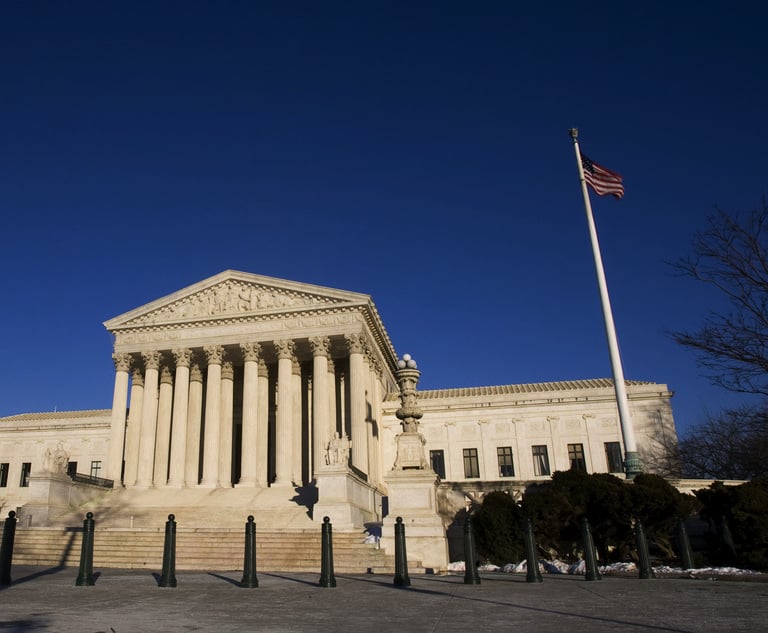
When the city of New Haven in 2003 tossed out a promotion test for firefighters after learning that no African Americans had passed, was it striking a blow for or against civil rights? The U.S. Supreme Court heard vigorous debate on that question last week in the case of Ricci v. DeStefano.
The court’s conservative bloc seemed inclined to side with the white firefighters who make up the bulk of the plaintiffs in the lawsuit against New Haven. “You had some applicants who were winners and their promotion was set aside,” Justice Antonin Scalia said.
The more liberal justices indicated that New Haven did nothing wrong by throwing out the test over concerns that it had an unintended but “disparate impact” on minorities in violation of the 1964 Civil Rights Act. The white firefighters, who attended oral arguments in their dress uniforms, said the decision violated the same law’s prohibition on intentional discrimination.
A ruling against the city, Justice David Souter said, could leave employers in a “damned-if-you-do, damned-if-you-don’t situation.” In friend of the court filings, business interests said that a victory for the white firefighters would place employers in an untenable position of having to choose whether to face lawsuits from disgruntled white or minority workers. “Whatever Congress wanted to attain” in writing the civil rights law, Souter said, “it couldn’t have wanted to attain that kind of a situation.”
Many court observers believe that Justice Anthony Kennedy likely holds the swing vote in deciding the case. His central role was so evident at one point that Justice Stephen Breyer, apparently hoping to win Kennedy over, posed a hypothetical based on Kennedy’s concurrence in a related 2007 civil rights case.
“I think you’re giving examples from Justice Kennedy’s” opinion, replied Gregory Coleman, lawyer for the white (and one Hispanic) New Haven firefighters who did not get promoted.
“That’s just what I’m doing exactly,” Breyer. For his part, Breyer seemed to favor New Haven’s position in the case.
Kennedy did not explicitly tip his hand, but seemed sympathetic to the white firefighters who claim they were discriminated against on the basis of race when the city did not give them the promotions.
Kennedy reacted sharply when Deputy Solicitor General Edwin Kneedler offered what he viewed as contradictory arguments. Kneedler said New Haven acted reasonably in withdrawing the test because of its disparate impact on minority applicants, but he also said that in doing so, the city was not drawing racial distinctions.
“I looked at the results, and it classified the successful and unsuccessful applicants by race,” Kennedy said. “And you want us to say this isn’t [about] race? I have trouble with this argument.”
‘Individual Dignity’
The white firefighters are represented by New Haven attorney Karen Lee Torre, a columnist for the Law Tribune. They have lost both at the district court and appeals court level, with rulings that found the city’s withdrawal of the test to be a valid remedy to an employment practice that was having a disparate impact on minorities.
Gregory S. Coleman, a partner at Yetter, Warden & Coleman in Texas, was brought in by the white firefighters to argue before the court. He was calm and persistent in making the case that racial classifications are “inherently pernicious,” and that New Haven’s actions harmed specific individuals—not hypothetical future victims —on the basis of race.
Coleman repeatedly referred to the damage to “individual dignity” involved when the city decided not to certify the exam after his clients had passed it.
Kennedy asked Coleman whether the city could, prospectively, choose a test to give candidates in the future that had been shown likely to pass a more diverse array of candidates. The question was designed, Kennedy said, “to ask you the question whether race consciousness is ever permissible.”
Coleman said his view was that a city could make that choice prospectively, because nobody who had already won promotion would have it taken away. Kennedy seemed mollified.
Representing New Haven, Christopher Meade, of Wilmer Cutler Pickering Hale and Dorr, also stuck to his main argument that the city, far from violating Title VII, believes it was upholding the law by eliminating a test that appeared to have a disparate impact on minority applicants.
“This race consciousness is race consciousness that’s mandated by federal law,” Meade insisted. “When an employer learns that a practice has a severe adverse impact such that it creates an inference of discrimination ... the employer should be granted some limited degree of flexibility to act.”
Chief Justice John Roberts Jr. questioned Meade skeptically, at one point asserting that the city was looking for “a blank check to discriminate.” He wondered whether the city could continue throwing out tests when it doesn’t like the results. “They get do-overs until it comes out right?” Roberts said.
“As one expected, the questions were vigorous and probing, particularly those challenging the city’s argument that the Constitution does not apply here because there was no injurious “race-based” action directed at individuals,” Torre said last week. “Given that the very individuals whose careers, salaries and pensions were wrecked by the city’s decision were sitting right there in the courtroom, I do not think the city’s attempt to dehumanize its decision was persuasive. But it is always unwise to draw conclusions based on the justices’ comments and questions.”
Personal Sacrifice
The stakes are high for those directly involved in the case. Torre has noted that these tests for promotion are given infrequently and that the plaintiffs bore significant expense and personal sacrifice to prepare during the three-month period prior to the test.
Frank Ricci, for example, to overcome dyslexia, paid to convert study texts to audio recordings; Gregory Boivin resigned from part-time jobs; and Christopher Parker studied in his wife’s hospital room as they awaited the delivery of their son.
But the stakes are also high for society in general. Legal experts say the ruling well may determine what public and private employers can legally do when a decision to avoid discrimination against one group of employees leads to discrimination against another group.
“I would feel very torn in advising an employer right now,” said employment law scholar Marcia McCormick of Samford University Cumberland School of Law. “As a practical matter, it seems employers can’t win no matter what they do here.”
In her view, the plaintiffs’ argument is “unworkable.” McCormick continued: “If recognizing race at all is discrimination, there is nothing an employer can do because anything it does is discrimination. Even surveying its own work force as to who is white, who is African-American, would become the roots of a discrimination claim.”
But Ilya Shapiro, of the libertarian Cato Institute, who filed an amicus brief supporting the plaintiffs, said the Supreme Court could offer advice to employers in its ruling.
“The guidance that the court needs to set out is: If there are not any allegations of racial animus or pretext in the testing criteria applied, then there should not be a basis for a suit,” she said.
A number of legal observers predicted a 5-4 split decision, though they differed on who might prevail. Employee counsel Paul Mollica, of Chicago’s Meites, Mulder, Mollica & Glink, spoke for others when she noted that this is not the typical job bias case that comes before the Supreme Court.
Mollica said more common cases often feature “lawyers’ issues” about bringing and proving these lawsuits. “This is not just for lawyers. It’s an important issue for municipalities and, conceivably, for private employers as well.” •
The Associated Press contributed to this report.